Research synthesis
Get more from the research you already have.
Connect findings across studies and waves so teams reuse what you know instead of starting over.

In short
Research synthesis combines findings from multiple studies, waves and reports into one answer. mTab works as your research repository: it brings trackers, ad hoc studies, verbatims and documents into one governed layer, answers questions with the studies cited, and flags when a new finding confirms, contradicts or extends what your team already knows.
The challenge
Research teams can spend most of a project preparing and harmonizing data, and each study still answers only the question it was commissioned for. Today's question usually spans several studies, decks and trackers held by different teams.
- 1
Connect
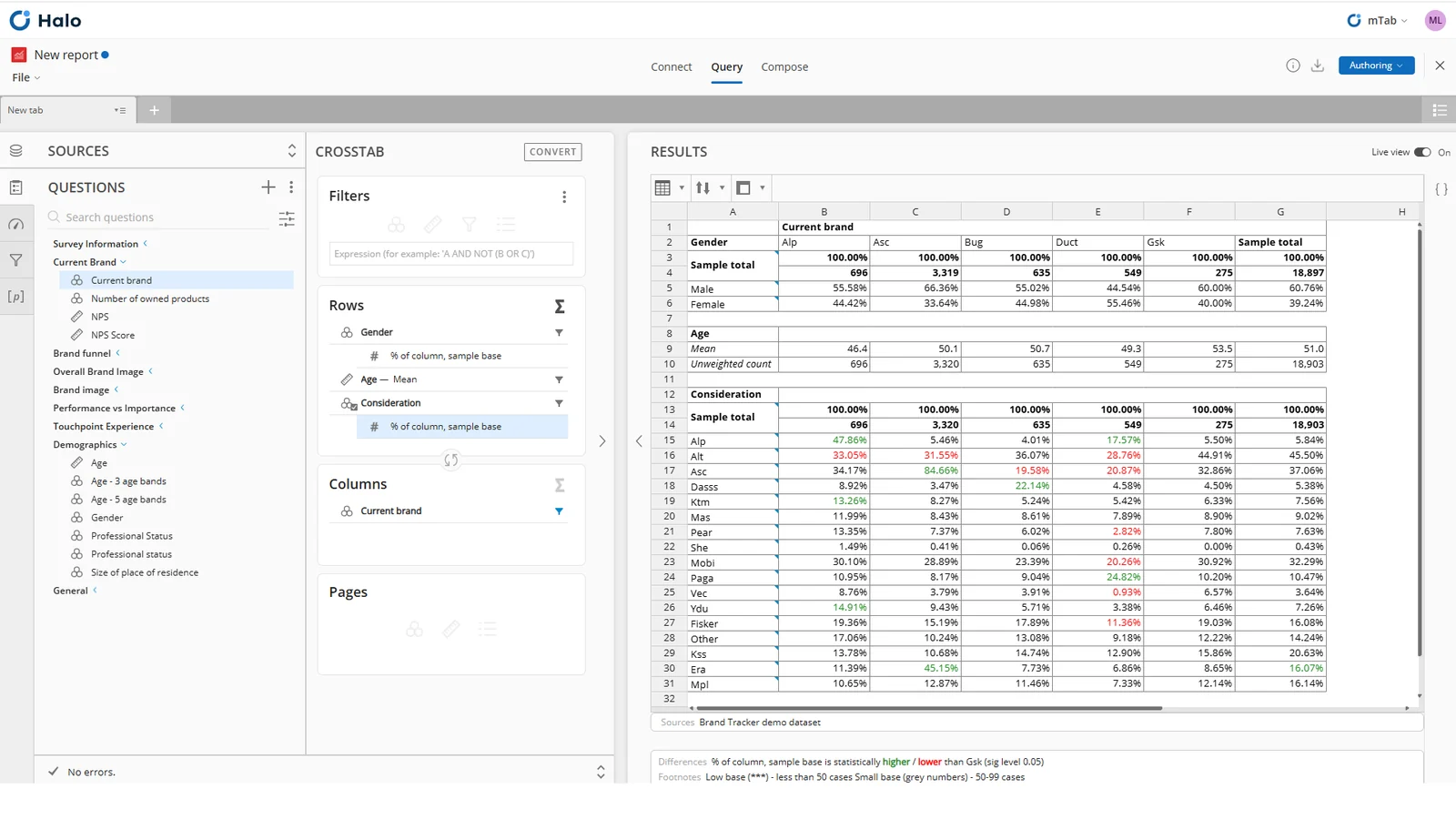
Halo brings trackers, ad hoc studies, reports, verbatims and documents into one governed layer.
- 2
Detect
Pulse flags when a new finding confirms, contradicts or extends what you already know.
- 3
Explain
Ask a question and get an answer grounded in specific studies, with the evidence cited.
- 4
Act
Turn the synthesis into a decision brief, or schedule a monthly synthesis Flow for recurring topics.
What changes for your team
-
All research in one place
Surveys, trackers, reports and documents, including PDF, PowerPoint, Excel and Word files, with access set by user and team.
-
Less time on data preparation
Harmonization, cleaning and organization that used to take most of a project now takes a fraction of it.
-
Past research put to work
Earlier studies provide context for current questions, so teams build on what is known instead of re-commissioning it.
-
Findings shared across the business
A governed hub where every relevant stakeholder can see the latest insight, without breaking research silos by email.
Platform capabilities
- Cross-study search and synthesis
- Answers with citations
- Decision briefs
- Monthly synthesis with Halo Flows
Halo Reports and your research
One governed home for every study.
Trackers, ad hoc studies, syndicated data and documents are brought together in Halo, so findings can be compared and trended across studies instead of rediscovered.
- Survey data harmonized across studies and waves
- Syndicated and internal research in one place
- Reusable reports instead of decks rebuilt every wave
Related reading
All articles
Research methods
Survey data quality: a guide to data quality in market research
A practitioner's guide to survey data quality: the total survey error view, quality checks from questionnaire design to reporting, a cleaning and weighting example, and how to explain data quality to stakeholders.
Research methods
Data harmonization: how insights teams make research data comparable
A practitioner's guide to data harmonization for insights teams: what to harmonize, how it differs from data integration, a step-by-step process, a rescaling example and the limits of what it can fix.

Decision intelligence
Decision intelligence for market research and insights teams
What decision intelligence changes for market research: continuous tracker monitoring, synthesis across studies, stakeholder questions answered from the research, and recurring reporting automated with governance intact.
FAQ
Research synthesis: common questions.
Which research formats can mTab synthesize?
Survey data and trackers, reports, verbatims and documents, including PDF, PowerPoint, Excel and Word files, with access set by user and team.
How does mTab show where an answer came from?
Every answer cites the studies, cuts and figures it draws on, so researchers can check the evidence before it is shared.
Can synthesis run on a schedule?
Yes. A monthly synthesis for recurring topics can run as a Halo Flow and arrive as a draft decision brief for your team to review.
Want to see research synthesis with your data?
Bring one tracker or study. We'll show you what Pulse would surface for your team before we meet.