Automotive briefing
EV Adoption Challenges Shifting As JD Power Reveals Owner Satisfaction Beats Gas Models

mTab
· 3 min read
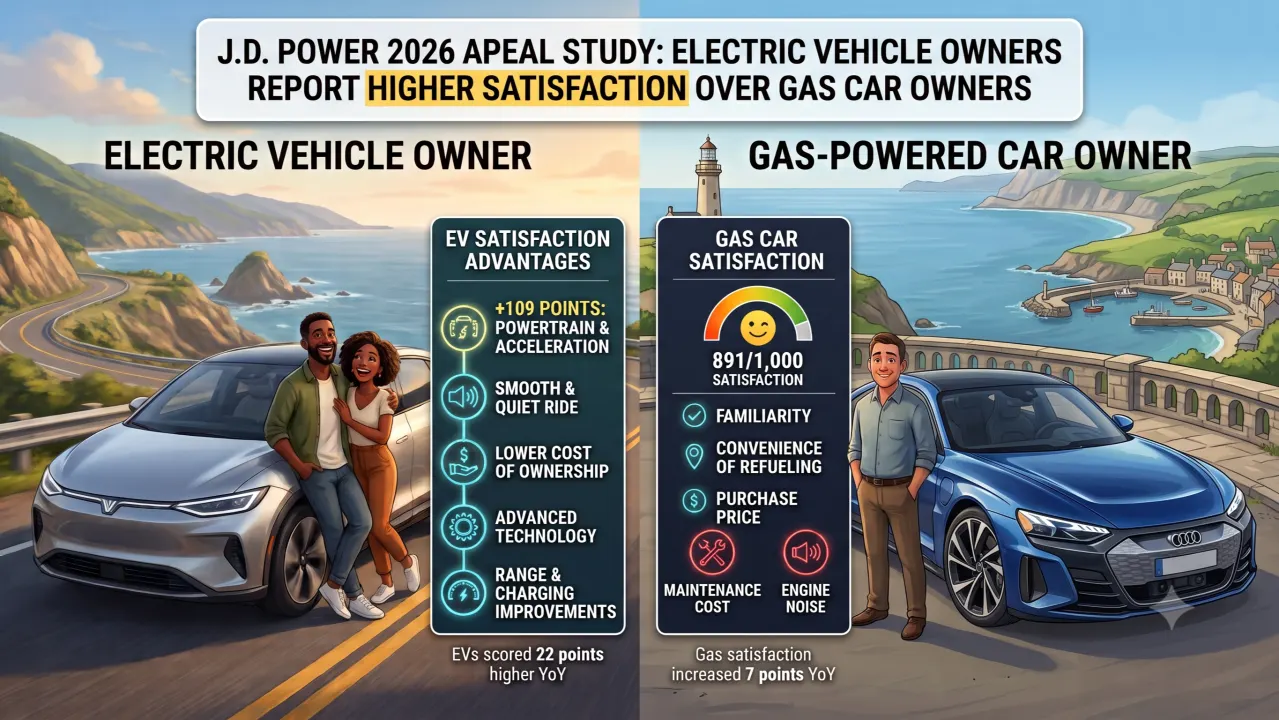
For the last few years, the industry narrative for electric vehicle automakers like Tesla, Ford Motor Company, Hyundai Motor Company, Rivian, Chevrolet and Lucid Motors has largely been focused on "convincing buyers that EVs are good." However, JD Power 's newest data says that this concern is turning the corner for electric vehicles as driver satisfaction has overtaken traditional gas-powered vehicles.
JD Power's 2026 APEAL study, surveying 78,514 owners of 2026 model-year vehicles, found EVs outscored gas vehicles by 109 points on powertrain satisfaction (on a 1,000-point scale) and led or matched combustion vehicles on the majority of 37 measured attributes. Overall new-vehicle satisfaction hit 858 points, up 7 points year-over-year — the largest single-year gain since 2018.
In other words, EV owners are happier with their vehicles than gas owners are with theirs. This shifts the focus to the next major barrier of ownership - price.
Why this matters right now
Every OEM insights team, including General Motors, Stellantis, Hyundai Motor Company and KIA Motors, has spent years building brand tracking and messaging around a "will EVs satisfy buyers" question that this study just answered decisively. That's a wasted rep if the tracking doesn't pivot. The open question for 2026 isn't experience; it's affordability and price perception, and that's a completely different set of signals to watch: financing terms, incentive uptake, trade-in economics, MSRP-tier consideration.
This isn't happening in a vacuum, either. Hybrids just hit a record 15.4% U.S. market share in H1 2026, nearly 3x pure-EV share, with Toyota Motor Corporation, Hyundai Motor Company, and American Honda Motor Company, Inc. controlling 86% of that segment and Toyota alone selling over 600,000 hybrids. Honda dropped its Prologue EV outright, and more than a fifth of Tesla trade-ins in Q2 went to hybrids. So while satisfaction data says EVs have won the product argument, buyers are still voting for hybrids in the showroom. That gap between satisfaction and actual purchase behavior is exactly where the price story lives, and exactly what static, quarterly BI refreshes are too slow to capture.
"The automotive market continues to navigate twists and turns. Now that EV satisfaction is outpacing traditional combustion powertrains, OEMs need to understand the impact on the market and how to shift their attention with buyers," explains John Sevec, Senior Vice President of Client Strategy at mTab. "This is why decision intelligence advancements are becoming increasingly vital to automakers to identify these twists, interpret the impact and immediately adjust their innovation, investments and strategies."
What incumbents miss
Traditional research and BI tools tell you what already happened, a satisfaction score, a quarter after the fact. The more useful question for a CI or brand leader right now is: what's the price perception gap doing to consideration, this month, in this MSRP tier, for this model line? That's a live signal problem, not a retrospective one, and it's the difference between reading a JD Power headline in the trade press and having the reframe in front of your leadership team before your competitors do. This is largely why automakers are embracing agentic decision intelligence - to anticipate these twists in the market's roadway to prescriptively respond with real-time strategic actions.
The move
Strategic OEMs are already reframing their market messaging conversations from "EVs are good enough" to "here's what's actually driving price hesitation," and adjusting their strategic pricing structures accordingly since the data supports the pivot.
Some automakers are also using this as the anchor proof point for a live pilot with an automotive account: show what it looks like to track a price-vs-satisfaction gap in real time instead of waiting for the next syndicated study.
Beyond this vehicle and campaign teams are being briefed so they can adjust their model and messaging strategies from "convincing" buyers to de-risking price.
With the satisfaction argument shifting, the next twelve months of automotive marketing will be won or lost on these pricing front.